
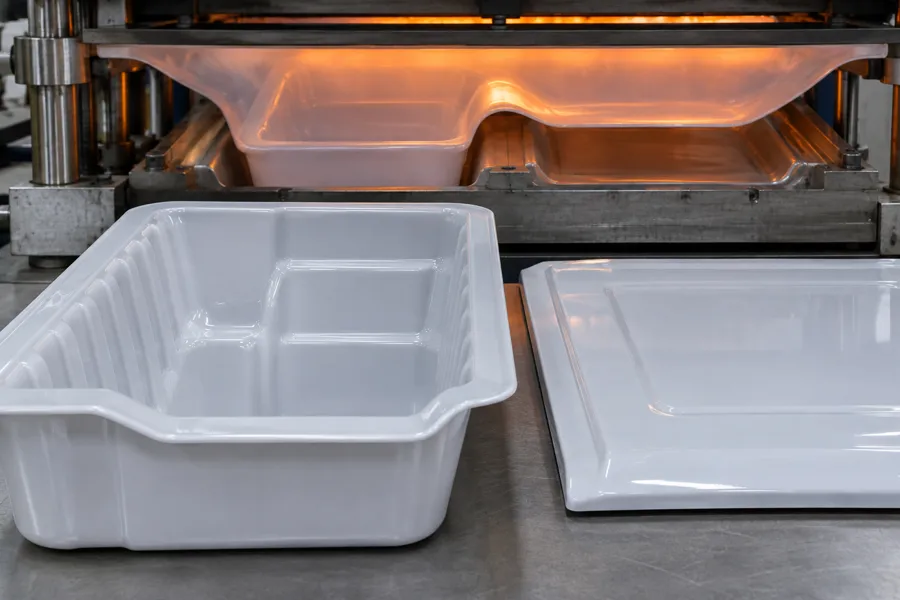
How the shape uses the sheet
For a shallow panel, start with a sheet extrusion grade that gives the required surface finish and forms consistently. A refrigerator liner with deep pockets also needs a suitable wall thickness after heating and drawing, impact resistance at low temperatures and resistance to the substances it will encounter in service. On an exterior panel, consider coextruding an ABS base with a weather-resistant cap.
The white liner of a refrigerator forms the pockets and the transitions between different depths. The clear drawers are separate parts. Blank dimensions and average draw give an estimate of material consumption, but they do not tell you how much material reaches each corner. The sheet touches raised features first. Once those areas are held against the tool, the adjacent pocket continues to stretch. On the trial part, map the thickness of the wall, the base, the transition and the deepest corner.
Read the thickness map on the formed blank
| Observation | First check on the current sheet | When to compare a different ABS |
|---|---|---|
| The wall is thin around one radius but acceptable around the next. | Compare the heating profile, sheet direction and where the draw is concentrated. See how the distribution changes with the pre-stretch available on your machine. | Compare grades if the result is still inconsistent after you have established a workable material distribution. |
| The visible surface whitens or loses its texture. | Compare the color and texture of the original sheet with the corresponding spot on the formed part. Record the surface temperature and local draw. | Compare cap materials if the current cap cannot achieve the required draw depth and finish together. |
| An edge moves out of position after trimming. | Measure the cooled part before and after cutting away the trim. Check its orientation relative to the direction of extrusion. | If the edge still moves with the process running steadily, compare shrinkage and residual stresses in the candidate materials. |
Grades to compare
- ELIX ABS E401 is a high-impact sheet extrusion grade. At −30 °C, its typical notched Izod impact strength is 19 kJ/m².
- ELIX ABS E310 is an option for a glossy ABS front where surface stiffness and resistance to cleaning products matter. Its tensile modulus is 2,200 MPa.
- CHIMEI PA749SK is a candidate for thick sheet extrusion. Compare blank sag and the wall thickness retained after a deep draw.
Select the face and structural layers
Single-layer sheet is practical when one formulation meets the color, impact and surface requirements. In a coextruded sheet, the structural layer supplies thickness and mechanical performance. The outer layer provides the shade, texture or weather resistance. Inspect coverage and the interface between layers on a drawn wall, where the face has stretched thinner.
Clean trim from a single-material sheet can go back into an agreed formulation after sorting and property checks. Trim from a multilayer sheet returns several polymers, colorants and additives to the blend. Use the actual layer structure to establish whether the trim can go into the core and how much you can use. Check variation in color and forming behavior from lot to lot.
A refrigerator liner in the cold and during cleaning
Keep a color reference from the flat panel. Compare cold impact on a sample from a deeply drawn section as well. For cleaning agents or other substances the liner will encounter, test formed sheet carrying the residual stresses typical of the part. A flat sample gives a reference point, while a deep pocket shows how the actual geometry performs.
Count trim and downtime in the cost per accepted liner
Record sheet mass per cycle, finished part mass, the proportion of trim you can actually reuse and the number of parts that pass trimming and inspection. Compare heating and cooling times. A heavier blank may save one thin corner while adding material across the whole panel. First check whether you can redistribute the draw on the sheet you already run.
Questions before buying resin
Can I use a familiar injection molding grade for sheet?
For production sheet, start with a grade recommended for extrusion and subsequent forming. A melt flow that suits injection molding tells you little on its own about the sag of a hot blank under its own weight.
What samples help when requesting a material?
Provide photos of both sides of the part and thickness readings from the flat, deeply drawn and transition areas. For color matching, include a sample of the visible surface after forming.
Can we keep the same color when we start using regrind?
Compare the core and the visible layer separately. If you keep the regrind in the core, check whether its shade shows through at maximum draw. Test impact and adhesion between layers after forming.
Related ABS materials
Browse the ABS family or explore ABS for electroplating.